Danger. My favorite Pylon song and favorite of many other fans.
My former colleagues who were there, especially those who attended the “100th Anniversary” show, will get a kick out of this video. “The time is short. You die at dawn.” LOL.
Danger Be careful Be cautious I’ll catch you unaware Look out I’ll get you You know this Be prepared I’ll catch you unaware Look out son Watch out Go for it
In the first paragraph of Grim Anniversaries, I could have been more clear that what I saw with Harriet was my impression of her situation and nothing more. She and I didn’t discuss her wellness at the time. A month or so later I mentioned to her that it appeared to be taking a toll on her physically, but she neither confirmed nor denied my observation.
The e-mail exchange at the beginning of Grim Anniversaries is verbatim. I tend to save electronic messages wherein I’m instructed to violate company policies and/or my oath as a member of the State Bar of Georgia.
A portion of Grim Anniversaries, beginning with the exchange of messages with Jane through the end of the scene, was the opening scene of the book in the first several drafts. However, having the story open with frantic messages, Damron terrified of something, then being unable to talk to Jane, sneaking out into the cold darkness to go home and have a meltdown, set a tone for the story that was too dark. And then the first six chapters would be flashbacks. The scene belonged where it happened chronologically, and I wanted the book, like the real story, to have its dark moments, but to be a story of perseverence, optimism, and humor. The scene works here. It’s the “all is lost” moment of Destination Unknown.
The story of Pylon is fascinating. To say that R.E.M. copied Pylon’s style would be unfair, but the unique sound of both bands was strikingly similar. Compare Pylon’s Gyrate (1980) with Chronic Town (1981) and Murmur (1983). Compare R.E.M.’s Reckoning (1984) with Chomp (1983). These cats were nourished by the same soil. Athens is a small town. A band becomes popular. Other bands spring up with a similar style and become more popular than the first. It happens all the time.
On the other hand, you have the story of Pylon’s offer to open up on a North American tour for a popular Irish band trying to make it big in the States called U-2. It would make more sense that U-2 would ask the B-52s instead, doesn’t it? From an aeronautically-named performance artists’ perspective? Maybe not. So intriguing that Pylon would have such close relations with two bands who went on to become among the most popular performers in the history of modern Rock.
In the above video, Michael explains how Pylon went on the tour for a few shows, but backed out because “it was the wrong crowd for us,” which is such an Athens thing to do. Athens people totally understand this. Athens is an incredibly diverse town with at least three of the most popular bands of all time in their respective genres (B-52s, pop/dance, R.E.M., rock, Widespread Panic, jam bands). Athens has a crowd for everyone, and everyone has a crowd for them. You don’t need to waste time being around the wrong crowd in Athens. As Vanessa says, when playing stopped being fun, they were out, which is also a totally Athens thing to do.
The grand entrance of the Sorceress in Stop It was one of the last scenes that I wrote. Every editor we interviewed seemed to love the sudden jolt of the story into the Sorceress’s netherworld. I thought I would need to clean up the transition in later drafts, but they all said no, it’s better this way. A real “blind-squirrel” moment for me as a writer.
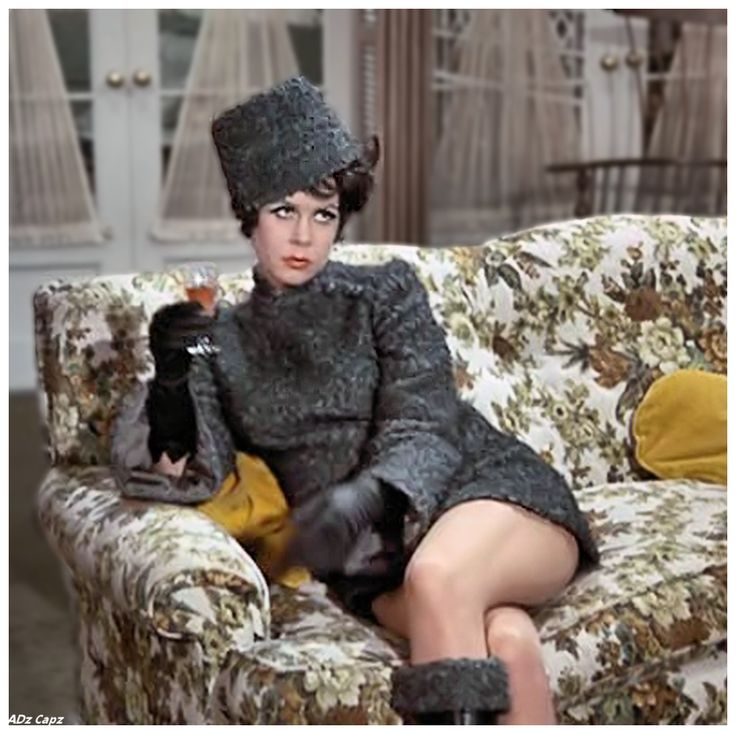
My real career coach and the Sorceress couldn’t be more different in real life, except that she really is probably a Size Two on a fat day and does look like Samantha Stevens’s hot cousin Serena on Bewitched, which is nice. The dialogue with the Sorceress about my situation(s) and what to do about it were all phone consultations and text/e-mail exchanges in reality.
But how boring would it be to read about phone conversations and e-mail messages between me and my career coach? Or exposition about her advice to me? Or a soliloquy directed at the reader? Neither would do, and when I decided to fictionalize the memoir, the Sorceress came into being and solved all of those problems.
I had a bit of pushback on the title “Night of the Long Knives” because one of my pre-pub readers thought the phrase related to the Nazis and the Holocaust and might offend Jewish readers. I polled a group of Jewish friends of mine who said the term wasn’t offensive at all and didn’t relate to the Holocaust directly. Rather than re-tell the history here, click here if interested: https://encyclopedia.ushmm.org/content/en/article/roehm-purge.
The purge did set the stage for further abuses of power by the Nazis, however, which is what I was alluding to with the title. See, e.g., the definition of the idiom.
You’re funny and you don’t know why You’re funny and you can’t even cry You’re funny and you don’t know why You’re funny and you don’t even try ‘Cause your head’s shaking and your arms are shaking And your feet are shaking ’cause the earth is shaking You’re hungry and you don’t know why You’re hungry and you can’t even cry You take a walk and you try to understand Nothing can hurt you Unless you want it to There are no answers Many reasons to be strong You take a walk, you take a walk You’re in love and you don’t know why You’re in love and you can’t even cry You’re in love and you don’t know why You’re in love and you don’t even try
Crazy is perhaps the best-known Pylon song because R.E.M. recorded a cover of the song, which was the b-side for the single Driver 8 (from their 1985 album Fables of the Reconstruction). Crazy was included on their first compilation, Dead Letter Office. Dead Letter Office was released in early 1987, a few months before R.E.M’s last decent studio album, Document. After Document, they signed with Warner Brothers and became superstars, even said by some to be the world’s greatest rock and roll band. I don’t know about that (The Grateful Dead is the world’s greatest rock and roll band, IMHO), but the band has stayed close to their Athens roots all this time.
Dr. Phinizy Spalding (for whom Phinizy in the story is named) was a legend in the UGA History Department and my favorite professer at UGA. He had a passion for his subjects and was very demanding, but was also a hip cat on the Athens music scene. He once invited a few of his students, myself included, to a cocktail party at his house on Cobb Street in Normaltown, and R.E.M. showed up. As it turned out, we students were invited because Dr. Spalding needed bartenders. I fixed a gin & tonic for Mike Mills and opened a Budweiser for Pete Buck.1
Company Ale on the Weekend was originally part of Night of the Long Knives, but the exposition was dragging on. I turned the exposition into a scene where the Sorceress comes to visit. In reality I think Tropicalia is just fine, but the gratuitous shot (if you worked there) was simply too funny to pass up, like the “stab your finger on the treble hook” line in Driving School (it’s actually a railroad spike, Lord knows why, but the purpose is similarly infantile).
The real Sorceress doesn’t drink or smoke (and may not wear minidresses) and is totally organic/paleo diet and probably has a whole closet full of Birkenstocks and buys all her clothes at REI. How she became the corporate sorceress is anybody’s guess.
Making the Sorceress as outrageous and irreverent as possible served the dual goals of making the story more entertaining, while relentlessly teasing the real Sorceress, which she and I both thoroughly enjoy.
“Sorceress, you’re like a Size2 on a fat day.”
I planned to drop the whole pink-polkadot-minidress bit at the end of Company Ale on the Weekend because I thought it was too corny. Then, Sandy and Melissa read it, and they thought it was one of the funniest moments in the book. I guess you never know. It does serve to make clear that the Sorceress is not my wife, but they do know each other and are great friends, which in the real story turned out to be crucially important.
1 While this may or may not have actually happened, note the proper Southern usage of the verb “fixed.”
Several points are worth mentioning about No Clocks.
The conversation with the Sorceress in No Clocks was actually a series of e-mail exchange a couple of months after the Weather Report scene, but I moved it to the end of Destination Unknown. Chronologically, it occurred around Chapter 11. With Jane having distanced herself, I had set out to find a different confidant-in-high-places but became frustrated at my inability to find one, and I reached out to the Sorceress.
I told her about my Asperger’s diagnosis and the rationale for finding a mentor/work buddy/explainer-of-things among the brokers, and she retorted with the customary two-by-four to the face, which she always used even before I told her about the diagnosis. That’s why I liked her and have worked with her for so long, which makes sense if you think about it.
I wrote No Clocks long before I wrote Work Stations, the opening-scene prologue. I wrote the prologue scene with Carol the psychologist after I decided that Grim Anniversaries couldn’t be the opening scene.
I had the fictionalized opening scene mirror all of the advice the Sorceress gave me, and perfectly bookended Destination Unknown. I really like how it turned out. After I came up with the ‘secondhand on Carol’s clock’ thing, No Clocks became the obvious choice for the title. The song is grinding but bright and ends with a flourish. Very epiloguey, I think.
“Damron, yoou are an idiot. To the brokers, you are an errand boy .”
At the law firm where I worked with Marie (discussed in Chapter 12, Mixed Drinks About Feelings), I became friends with a paralegal at the office who grew up in London. She was a young black woman (to describe her as African-American would be wrong on both counts) and quite fetching, as they say across the pond, and her thick English accent added to the allure. We were wasting time yapping and talking about going out to bars (we were both single at the time), and she said “I don’t go to bars much. I mean, two drinks and I’m anybody’s,” which I thought was the funniest thing I ever heard.2
After I sent out the announcement of the book’s publication, that young woman, now married with a family, was among the first to reach out to congratulate me. We hadn’t spoken in at least 12 years. I pointed her to No Clocks and told her I never forgot that line. She and I had a nice reunion drink a few weeks later.
2 Yeah, yeah, I get it now. She was giving me a flirty invitation, and I totally missed it. What more proof do you need? A great feature of missing flirty invitations is how the fetching invitor then either thinks I’m a clueless dork or a total jerk. Meanwhile I merrily go about my way, unaware of how her impression of me has changed. Much more discussion of this in Gray Rock and beyond.
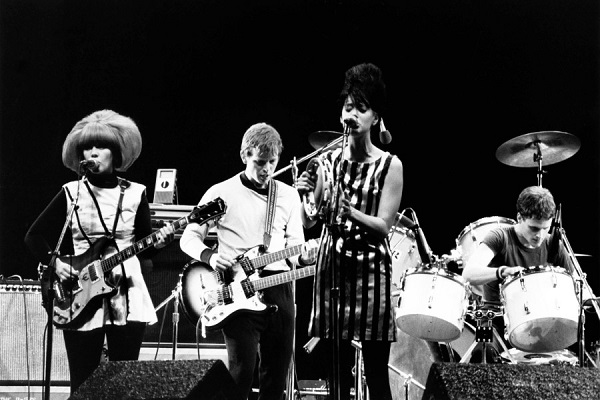
This grainy video shows one of the research team’s early performances, with Damron (vocals, keyboards/percussion), Harriet (vocals, keyboards, bass synthesizer), Penelope (vocals, percussion), Warren (lead guitar), and Rudy (drums), welcoming the new regional research director, Claire.
She came from Planet Claire I knew she came from there She drove a Plymouth Satellite Faster than the speed of light Planet Claire has pink air All the trees are red No one ever dies there No one has a head Some say she’s from Mars Or one of the seven stars That shine after 3:30 in the morning WELL SHE ISN’T
I wrestled with the end of Destination Unknown and the beginning of Gray Rock for several weeks, trying to end one story definitively while beginning a very different one. Eventually I sorted out everything between the parts, but two items never in doubt were (a) my team, and the music for Gray Rock, was The B-52s and (b) Claire would be named Claire. Planet Claire is the first track on the first studio album the band released, and thereby it became the first chapter name of the new world of Gray Rock. Matching the song titles to each chapter thereafter was easy.
I mentioned in the Working is No Problem notes that I had the scripture from the Book of James printed and tacked to the wall of my workstation. Next to the scripture, I had tacked the quote that is the epigraph of Gray Rock. I often wondered if anyone noticed them and wondered why I selected those quotations. No one did. At the time, naturally, they were there to remind me to be steadfast, and to stick to my mission. The Bhajan quote was, at the time, directed at The MP, but as I pulled together the manuscript, I noticed others at the company about which the same could be said, for better or worse. One person in particular.
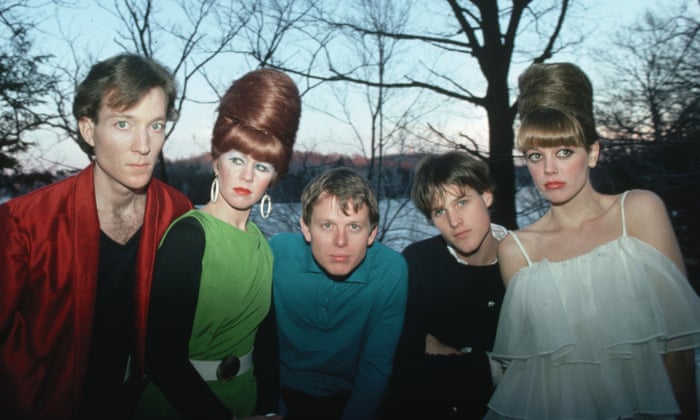
Keith Strickland (Rudy), Cindy Wilson (Penelope, lead vocals on this track), Fred Schneider (Damron), Kate Pierson (Harriet), and Ricky Wilson (Warren), are ready to quickly solve any minor issue that might balloon into a problem.
Nip it in the bud I say ‘Froze you’ Nothin’ I can do Can’t give it in You lock me out Nip it in the bud I don’t know Give it a shove Head ’em up Move ’em out I’m no fool! Ain’t got no place to go I don’t know, I don’t care If you just go on and get me there Oh, I don’t want to ruffle your feathers I don’t care if you don’t go I’ll just go do and beware Say, come take me away Nip it in the bud
I wanted Destination Unknown to move quickly, and after 53 Miles West of Venus (Chapter 16), there’s no time for background information on characters and Asperger’s. The background finally landed in the first half of Gray Rock. I attempted to deliver information with a humorous tone, and yeah, Nip It in the Bud is a love letter to the kids who were on my team, but cut me some slack.
Almost all of Nip It in the Bud was originally located in Destination Unknown. Phinizy’s team was actually seven terrific people, but that would be far too many characters. Isabel and Summer were materially involved in the story, but I think the world of Phinizy and everyone who was on his team.
The events described from Stop It (Chapter 8) through Nip It in the Bud were all happening simultaneously in late 2017-early 2018, as evidenced by the flashback scenes in Planet Claire. Claire didn’t come onto the scene until sometime after the conclusion of Crazy (Chapter 9), but the Dagmar episode occurred even before Stop It, and the Hard Reset occurred after Briar Patch and before the Night of the Long Knives episode. Clear as mud, right?! The time period was a muddled mishmash for me, as were the initial drafts of this part of the story.
By late 2017, I had come to understand the person with whom I was dealing, but hadn’t settled or learned what I should do about it, while under the pressure of possibly being fired on any given day. And on the other hand, I was dealing the dissonance of everything coming together very well with my team and Phinizy’s team substantively in the “actual work we are accomplishing for the brokers” portion of my job. Telling the story chronologically wouldn’t work here – I pulled out the “actual work” parts of my experience out of Destination Unknown and started anew.
Although we were poking a little fun at them in the process, the brokers in the office always went wild over this tune (dial up the video to 0:43, and you’ll see).
You’re living in your own Private Idaho Underground like a wild potato Don’t go on the patio Beware of the pool, blue bottomless pool It leads you straight right throught the gate that opens on the pool You’re living in your own Private Idaho Keep off the path, beware of the gate Watch out for signs that say “hidden driveways” Don’t let the chlorine in your eyes blind you to the awful surprise That’s waitin’ for you at the bottom of the bottomless blue pool You’re out of control, the rivers that roll You fell into the water and down to Idaho Get out of that state Get out of that state you’re in You better beware
All of the first half of Gray Rock was fun to write, but assembling and connecting the middle chapters thereof (11, 12, and 13) gave me a great deal of difficulty. Little if any of the material resided in the first half of Gray Rock in the early drafts. Most of the material was originally in Destination Unknown, and a decent portion was in Across This Antheap (Part Three).
Private Idaho switches to the other side to describe others in the office who weren’t on my or Phinizy’s team, and a bit of detail on what our jobs entailed. Most of this chapter was originally in Across This Antheap, but I decided to move it here to set up the ‘long game’ conflict of the entire story.
In retrospect, I could have placed more emphasis on Gray Rock’s ‘catalyst’ moment, which occurs in Private Idaho: the MP isn’t going anywhere, only growing in power and influence, and will never support, only undermine, my work.
With almost a year of working together under our collective belt, the team is performing great and receiving some recognition around the office and beyond, Harriet and Penelope in particular, as shown here. Learning to print! All of it’s hot!
We’re in the basement, learning to print All of it’s hot 10-20-30 million ready to be spent We’re stackin’ ’em against the wall Those gangster presidents Livin’ simple and trying to get by But honey, prices have shot through the sky So I fixed up the basement With what I was a-workin’ with Stocked it full of jelly jars And heavy equipment We’re in the basement 10-20-30 million dollars Ready to be spent Walk into the bank, try to pass that trash Teller sees and says “Uh-huh that’s fresh as grass” See the street pass under your feet In time to buy the latest model getaway Jeep We’re in the basement Learning to print All of it’s hot All counterfeit
I worried that the first half of Gray Rock gets bogged down with too much exposition, and I tried to follow the writing adage about “every scene requires conflict of some kind.” While the story talks about the relationship between Damron and his cohorts, his team and the brokers they served, and how Asperger’s can affect a person in a busy office environment, conflict with the MP simmers in the background. Hopefully the reader senses something is coming, but not when or where (as Damron thinks to himself at the very end of No Clocks).
The title Mixed Drinks About Feelings is an inside joke between Penelope and me, and this scene was originally way up in Precaution (Chapter 3) because the conversation occurred only a few weeks after I started at the company. But the scene works better here because Penelope rarely appears before the second half of Gray Rock, and it’d be strange how my ‘best friend at work’ disappears for almost half the book.
Likewise, Subtext originally appeared early in Destination Unknown, and moving Subtext and Mixed Drinks was among my last decisions before shipping off the manuscript to Sandy the editor.
The team (from left, Warren, Penelope, unidentified drug-sniffing dog, Rudy, Harriet, Damron) recorded this Yoko Ono track, which was used as the theme song played as the intro and outro for each month’s rendition of The MP Show!!!
Dont’ Worry, Garbage Can, and 53 Miles West of Venus were the last pieces of the story I wrote –These chapters are chock full of inside jokes between me and people in the office. These were the final pieces the story needed to proceed into the second half of Gray Rock. As with the previous chapters, these were fun to write but very difficult to arrange and link. Because I already had 100,000 or so words under my belt and felt confident. These chapters required almost no editing.
In early promotional efforts, we were asked to send excerpt of the book, and I chose Don’t Worry. Both Impresssion Management and The MP Show!!! are more stories than scenes, and contain little about Asperger’s, but I thought Don’t Worry stood alone well for those who knew nothing of the book but the back cover description.
In Impression Management, the “props” story is true and still amazes me, and the e-mail to me is verbatim, but the little faux-spat with Isabel about the quotation written on the wall was actually with Jane and happened in Yo-Yo (Chapter 4). I was going to cut it, but I thought my former teammates would get a laugh out of it – I made my displeasure with the writing on the wall abundantly clear with each of them as well.
For The MP Show!!! I unleashed my inner Dennis Miller and called it like I saw it. I took to calling the monthly meeting The MP Show shortly after I came to understand with whom I was dealing.
My editor Sandy lives in upstate New York. During editing we had a misunderstanding all southerners will appreciate. I wrote:
Sandy, Yankee that she is, having never experienced the pleasure of a Chick-Fil-A chicken biscuit, inserted a comma after chicken, i.e., “…dished out every month along with free chicken, biscuits and coffee.”
I wrote in the margin. “Sandy what the hell is wrong with you? Have you never heard of Chick-Fil-A?!” She had heard of it but had never seen one, the closest location being in New York City a few hundred miles away, and didn’t know they have chicken biscuits on the breakfast menu. I threatened to fire Sandy but didn’t mean it.
Although certainly not a point of pride or our finest hour, the MP’s leadership council seems to enjoy this performance at their quarterly meeting, which Phinizy and Isabel described as “like some ongoing, never-ending soap opera.” This performance also marked the begining and end of the short-lived “Penelope plays saxophone” experiment.
Here it comes again, drivin’ me nuts Can’t control my feet or stop shakin’ my butt The neighbours are complaining, it’s getting out of hand Throw that beat in the garbage can Stop that beat, it makes me apprehensive Sweat ruins my clothes, they are very expensive
Like the Transcontinental Railroad engineers driving a golden spike into the story’s track, the very final scene written was the conversation in Twenty-Two between Damron, Phinizy and Isabel. The exchange with Phinizy was the last scene I wrote was because I had forgotten about what happened, and Phinizy had forgotten that he told me about it. He reminded me of the story when I was almost finished with the manuscript, and I’m glad he did. I think it provides an important piece of the larger puzzle for the reader, and references the title of the book to boot.
The story of Twenty Two made me realize I could never fully succeed in my role so long as the MP was my “manager.” I didn’t include this inner monologue in the book until later in the story because I thought it would detract from the central conflict approaching. I was still unaware that what was happening to me had a name, but I knew I’d have to get out, but not how or to where. I loved everything else about the company and could hardly bear the thought of leaving the team.
I felt uncomfortable introducing Claire in Planet Claire and then making little or no mention of her again until the midpoint of the book, but scenes with me telling her how well things were going and her telling me I’m awesome would be boring. However, not introducing Claire until the midpoint of the book wouldn’t do. Accordingly, I made the conversation in De-Skilling, which in reality was with Harriet and Penelope, a touch point with Claire before everything unravels. I did have many conversations with Claire similar to De-Skilling, trying to gently warn Claire that I was in a highly dysfunctional situation in my local office.




 Best Places To Work!